
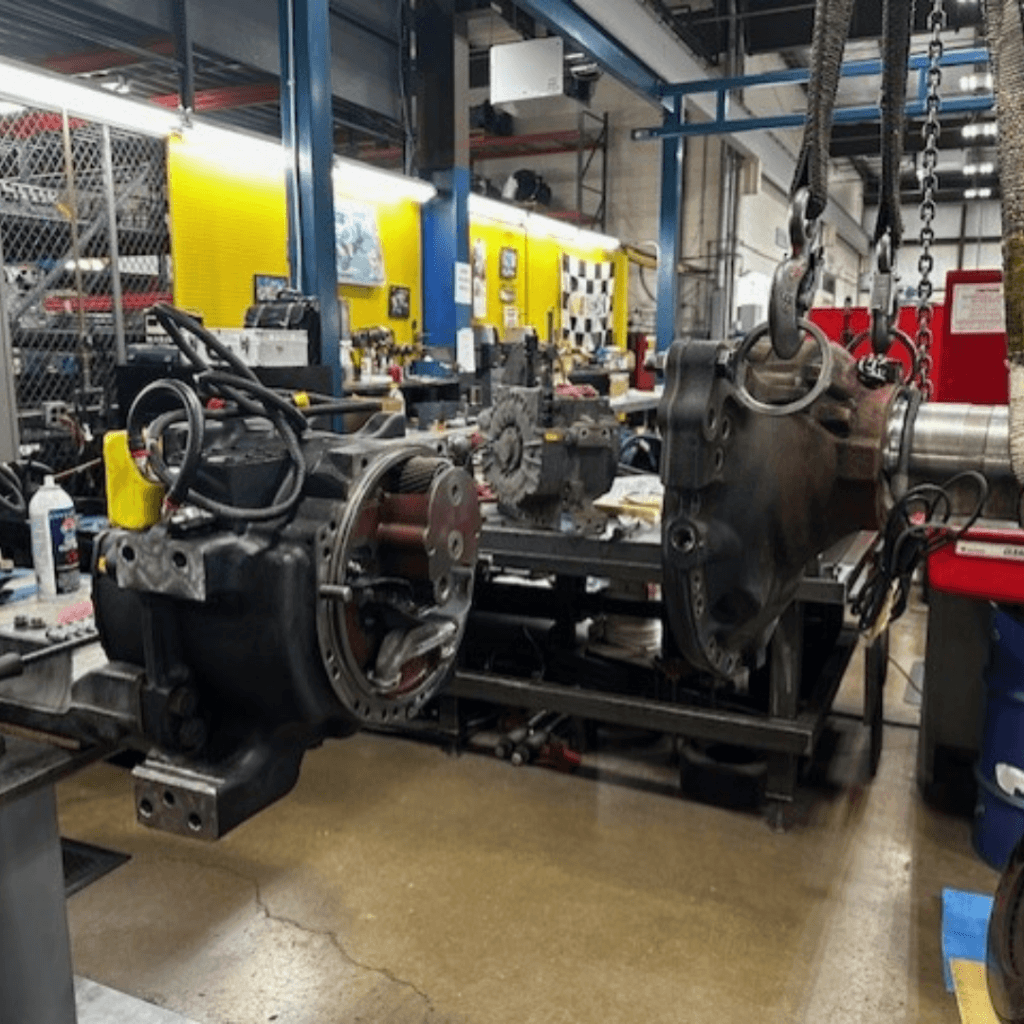
A transmission failure doesn’t care what brand nameplate is on the housing — it stops the machine the same way whether it’s a ZF unit in a wheel loader or an Allison in a transit bus. But when a fleet manager is staring at a downed unit, the real question isn’t just “what’s wrong,” it’s whether this specific brand and model can actually be repaired, or whether they’re looking at a longer road. The honest answer is that most major heavy-duty transmission brands can be repaired — but “can” and “should” aren’t always the same question, and the right call depends on a handful of specific factors.
What Actually Determines Whether a Transmission Can Be Repaired
Brand name isn’t the deciding factor — condition, parts access, and control-system complexity are. A unit with a cracked housing, a core that’s been run dry, or severe gear damage may be structurally past the point where a repair makes sense, regardless of brand. Parts availability matters just as much: brands with strong OEM or distributor support move through repair fast, while orphaned or discontinued lines can stall a job waiting on a core component. And for anything built on electronic controls — TCU-managed shifting, software calibration, fault-code diagnostics — the technician doing the work needs access to the actual documentation and tooling for that control architecture, not just mechanical know-how.
So, Can Any Heavy-Duty Transmission Brand Be Repaired?
For the brands that show up most often in heavy-duty and off-highway fleets, yes — with the caveats above. Here’s how that breaks down by category.
Off-Highway and Construction Brands
ZF Off-Highway units — Ecomat, Ecolife, AS Tronic, Traxon, TC Tronic, and the ZF 4WG98 line — are repairable across the board when the core and control system are intact, and this is an area we work in constantly as a ZF Off-Highway distributor with OEM-level parts access and software support. Dana and Spicer powershift transmissions and axles, Funk transmissions, Allison automatics, Liebherr units, Twin-Disc, AxleTech, and Clark transmissions are all brands we regularly diagnose, repair, and rebuild for construction and off-highway equipment.
Bus and Motorcoach Transmissions
Transit and motorcoach fleets running MCI, Prevost, Newell, Vanhool, Newflyer, Orion, Gillig, Caio, Proterra, or Volvo platforms are working with transmissions that are just as repairable as their off-highway counterparts — the difference is duty cycle. Stop-and-go city routes put different stress on clutch packs and torque converters than long-haul highway runs, which changes what failure modes show up first.
Material Handling Equipment
Forklifts and telehandlers from JLG, Caterpillar, SkyTrak, Lull, Hyundai, Hyster, Yale, and Manitou bring their own wear patterns — frequent directional changes and load-shift stress tend to hit clutch packs and hydraulic control components hardest. These are among the most common units we see come through for repair.
When Transmission Repair Isn’t the Right Call
Repair makes sense for an isolated, confirmed-contained issue — a failed seal, a single worn component, a fault code tied to one sensor. A full rebuild fits worn clutch packs, degraded bearings, contaminated fluid history, or a unit that’s overheated repeatedly but is still structurally sound. Once a core has severe gear damage, a cracked housing, or has been run dry long enough to score internal surfaces, heavy-duty transmission remanufacture is usually the smarter path — a fully disassembled unit rebuilt with all wear parts replaced and tested to factory spec, rather than a patch job on a housing that’s already compromised. It’s also the better call when you need the unit back in service fast: because we keep a large core inventory, exchange remanufactured transmissions can often be built in 3-5 days, which beats waiting on a from-scratch repair with an uncertain parts timeline.
Where ZF Off-Highway Expertise Makes the Difference
ZF units are where the “can it be repaired” question gets the most nuanced, because so much of the modern lineup runs on electronic control systems layered over the mechanical hardware. A Traxon or AS Tronic fault code doesn’t always mean a mechanical failure — it can be a calibration issue, a sensor fault, or a software problem that looks identical to hardware failure from the operator’s seat until someone with the right diagnostic access actually pulls the codes. As a ZF Off-Highway distributor for decades, we have the technical documentation, software tools, and OEM-level parts access to diagnose that correctly the first time, rather than guessing at a mechanical teardown for what’s actually a control-system issue.
Minimizing Transmission Downtime When You’re Not Sure
The earlier a failing transmission gets looked at, the more repair options stay on the table. Watch for slipping or delayed engagement, unusual noise under load, fluid that’s discolored or smells burnt, and any TCU fault code — waiting on these signs is what turns a contained repair into a full rebuild or remanufacture decision. Routine fluid and filter service, along with keeping cooler lines clear, is the simplest way to keep a unit in the “repairable” category longer.
Frequently Asked Questions
Is there any heavy-duty transmission brand you can’t repair?
Structural damage — a cracked housing, severe gear damage, or a core run dry for an extended period — can put any brand past the point of practical repair, regardless of manufacturer. Brand isn’t the limiting factor; condition and parts access are.
How do you know if a transmission needs remanufacture instead of repair?
If the core has sustained structural or widespread internal damage, or if a fleet needs the unit back fast, a remanufactured exchange unit is usually the better path than a from-scratch repair.
Do older or discontinued transmission models still qualify for repair?
Often, yes, as long as core components and documentation are available — this is where distributor relationships and a strong core inventory make a real difference versus a general shop.
Does a remanufactured transmission perform as well as a repaired one?
A remanufactured unit is fully disassembled, has all wear parts replaced, and is tested to factory spec on a dynamometer before it ships — for a core with significant damage, that typically outperforms a targeted repair on a compromised housing.
Get a Straight Answer on Your Unit
Every brand, every failure mode, and every fleet’s timeline is a little different — which is exactly why “can this be repaired” isn’t a question with a one-size answer. Tell us the make, model, and what you’re seeing, and we’ll tell you plainly whether you’re looking at a repair, a rebuild, or a remanufactured exchange. Start at our contact page, or call us directly: Colmar, PA — 215-822-8300, Fort Myers, FL — 888-343-8912.