
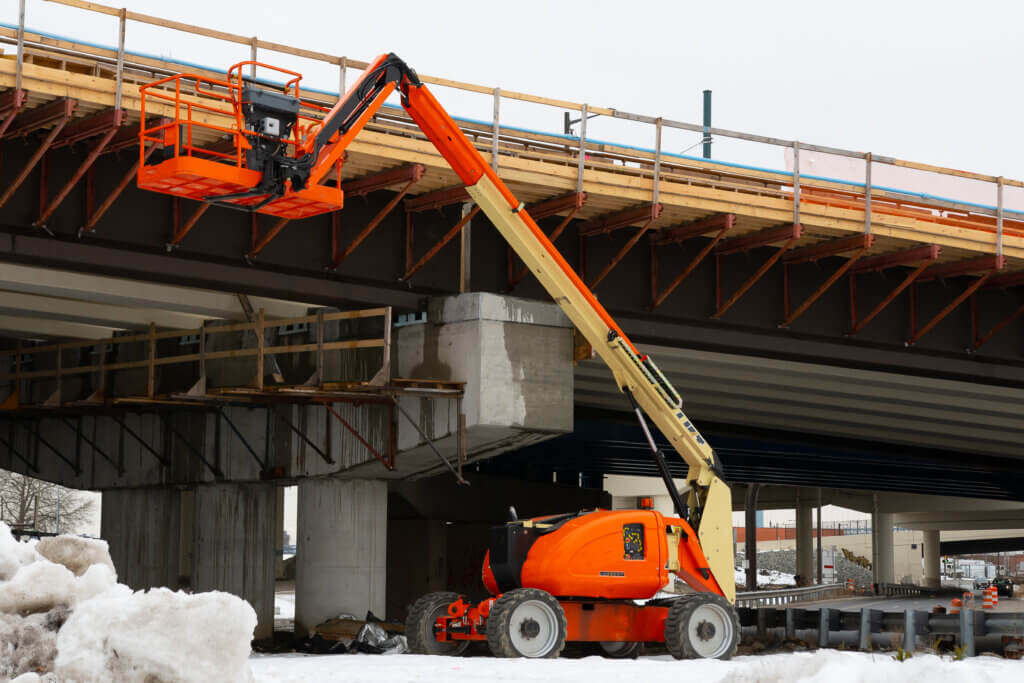
Off-highway equipment doesn’t idle quietly when a transmission fails — a crane sits off a job site, a loader misses a grading deadline, a forklift backs up an entire warehouse floor. Off-highway transmission repair is a different discipline than standard truck work: these units run under constant load cycling, extreme torque spikes, and duty cycles that would burn out an on-highway transmission in months. Getting the wrong shop on the job usually just delays the real failure a few months down the road.
What Makes Off-Highway Equipment Transmissions Different
An on-highway transmission is built around one dominant condition: sustained speed on a relatively flat, predictable load. Off-highway equipment transmissions face the opposite — full-load engagement from a dead stop, constant directional changes, and torque spikes that build in seconds rather than over miles. Cranes add rotational and lifting stress on top of that; construction equipment adds abrasive contamination from the work environment; material handling equipment adds high-frequency forward/reverse cycling, often for a full shift without a break in duty cycle.
That combination is why these units rely so heavily on planetary gear sets, torque converters, and — in more advanced ZF Friedrichshafen and Allison models — electronically controlled clutch packs. Any one of those systems failing takes the whole machine out of service, which is why off-highway transmission repair calls for a shop that’s already diagnosed these specific failure patterns, not one working from a general truck-repair background.
Off-Highway Transmission Repair: Common Problems by Equipment Type
Off-highway transmission repair issues tend to cluster by equipment category, since duty cycle and design vary so much between a crane, a loader, and a forklift.
Cranes: Hydraulic Control Valve Sticking and Clutch Pack Wear
Crane transmissions — commonly Liebherr, ZF, Twin-Disc, and Carraro units — combine planetary gearing with hydraulic control systems that manage load-sensitive shifting under lift. The most common failures we see are hydraulic control valve sticking, which causes delayed or harsh shifts under load; clutch pack wear from repeated high-torque engagement; and seal degradation from constant thermal cycling between idle and full-load lifting.
Construction Equipment: Contamination and Torque Converter Overheating
Dana/Spicer and Funk transmissions dominate excavators, wheel loaders, and haul trucks, alongside ZF powershift and Ecomat/Ecolife units in newer fleets. Contamination is the single biggest driver of failure here — dirt and debris working past worn seals accelerates wear on gear sets and bearings well before it’s visible in performance. Torque converter overheating is the second most common issue, usually traced back to restricted cooler lines or fluid that’s overdue for a change.
Material Handling: Directional Clutch Wear from Cycle Repetition
Forklifts, telehandlers, and similar equipment from JLG, Hyster, Yale, Manitou, and Caterpillar run through hundreds of forward/reverse cycles per shift. That repetition wears directional clutch packs and control valves faster than almost any other off-highway application, which is why material handling transmissions often need rebuild attention on a shorter interval than crane or construction units logging comparable total hours.
Off-Highway Transmission Maintenance and Warning Signs
Most off-highway equipment transmissions give warning before they fail outright — catching it early is almost always cheaper and faster than waiting for a full breakdown.
Maintenance Tips
- Check transmission fluid condition on a set schedule, not just fluid level. Dark, milky, or metal-flecked fluid signals internal wear even if the level looks fine.
- Inspect cooler lines for restriction regularly. A partially blocked line raises operating temperature gradually, so it won’t show up as a sudden problem until real damage is done.
- Don’t ignore intermittent fault codes on electronically controlled units. On ZF and Allison transmissions especially, a code that clears itself is still worth logging and tracking.
- Follow the OEM service interval for your specific duty cycle, not a generic calendar interval. Heavier-than-average use — extended shifts, high-cycle material handling — shortens the real interval even if the manual lists a longer one.
Warning Signs to Watch For
- Fluid that’s dark, milky, or carrying visible metal particles — a direct sign of internal wear or contamination.
- A pattern of temperature warnings, rather than a one-time spike, pointing to a cooling or restriction issue.
- Delayed, harsh, or inconsistent shifting, especially under load — often the first sign of clutch pack wear or a hydraulic control issue.
- An intermittent fault code that keeps returning, even if the equipment “feels fine” between occurrences.
ZF, Dana, Allison, and Other Off-Highway Transmission Brands We Service
OEM-level reliability only holds up if the shop actually has depth on your specific brand, since repair processes and tolerances differ across platforms. As a ZF Off-Highway distributor for decades, ZF is where our depth runs deepest — Ecomat, Ecolife, AS Tronic, Traxon, TC Tronic, and EP units, along with the hydraulic and electronic control systems built into them. Beyond ZF, we work on Dana/Spicer and Funk transmissions common in construction equipment, Allison units across mining and energy applications, Liebherr and Twin-Disc transmissions in crane equipment, and Carraro axles. On the material handling side, we service transmissions in JLG, Caterpillar, Hyster, Yale, and Manitou equipment.
Benefits of Professional Off-Highway Transmission Repair
Professional off-highway transmission repair pays off in ways that go beyond just getting the machine running again. The benefits that matter most to fleet managers and equipment owners:
- Fewer repeat failures. A shop that diagnoses the actual root cause — a restricted cooler line, a specific worn clutch pack, contamination that’s already spread to bearings — fixes the problem instead of just replacing the part that failed first. Guessing at parts without a real diagnosis is how the same failure comes back in six months.
- OEM-level reliability. Repairs and rebuilds done with OEM-certified parts hold to the tolerances the equipment was engineered for, which matters most in high-load applications like crane lifting where a mismatched or marginal part introduces a real safety risk, not just a performance one.
- Verified performance before it ships. Every remanufactured unit we build is load-tested on one of our three in-house dynamometers, so you know the unit performs to spec before it’s back on your equipment — not after.
- Warranty protection. Remanufactured units come with a 1-year, unlimited-hours warranty, which is coverage you don’t get from a rebuild-only shop working with limited testing capability.
- Less total downtime. Getting the diagnosis right the first time, backed by parts availability from a large core inventory, means fewer trips back into the shop over the life of the equipment.
Skipping professional off-highway transmission repair in favor of a quick patch usually costs more in the long run — a second breakdown, a longer parts search, or damage that spreads to components that were fine the first time around.
Frequently Asked Questions
How is off-highway transmission repair different from truck transmission repair?
Off-highway transmissions face constant full-load engagement, rotational stress in cranes, or high-frequency directional cycling in material handling equipment — conditions on-highway transmissions never encounter. The repair approach, parts sourcing, and diagnostic process all differ by equipment type and brand.
Should I repair or replace my off-highway equipment transmission?
It depends on what’s actually damaged. An isolated issue can often be repaired directly; documented overheating or worn wear parts usually call for a full rebuild; and a severely damaged core — a cracked housing or extensive gear damage — is typically better served by a remanufactured exchange unit.
What brands do you work on for off-highway equipment?
We service ZF, Dana/Spicer, Funk, Allison, Liebherr, Twin-Disc, and Carraro transmissions and axles, along with material handling units from JLG, Hyster, Yale, Manitou, and Caterpillar.
How fast can I get my equipment back in service?
It depends on the unit and what’s needed. We keep a large core inventory, so exchange transmissions can often be built in 3-5 days — contact us to confirm availability for your specific make and model.
Get Your Equipment Back in Service
Off-highway transmission repair isn’t something to hand to a general-purpose shop — the failure modes, parts sourcing, and testing standards are specific to each equipment category and brand. Every remanufactured unit we build is load-tested on one of our three in-house dynamometers before it ships, and backed by a 1-year, unlimited-hours warranty.
If you’re dealing with a crane, construction, or material handling transmission that needs to be done right, reach out through our contact page. Tell us the unit, the symptoms, and your timeline — we’ll route you to the right specialist at our Colmar, PA (215-822-8300) facility or our Fort Myers, FL (888-343-8912) facility.