
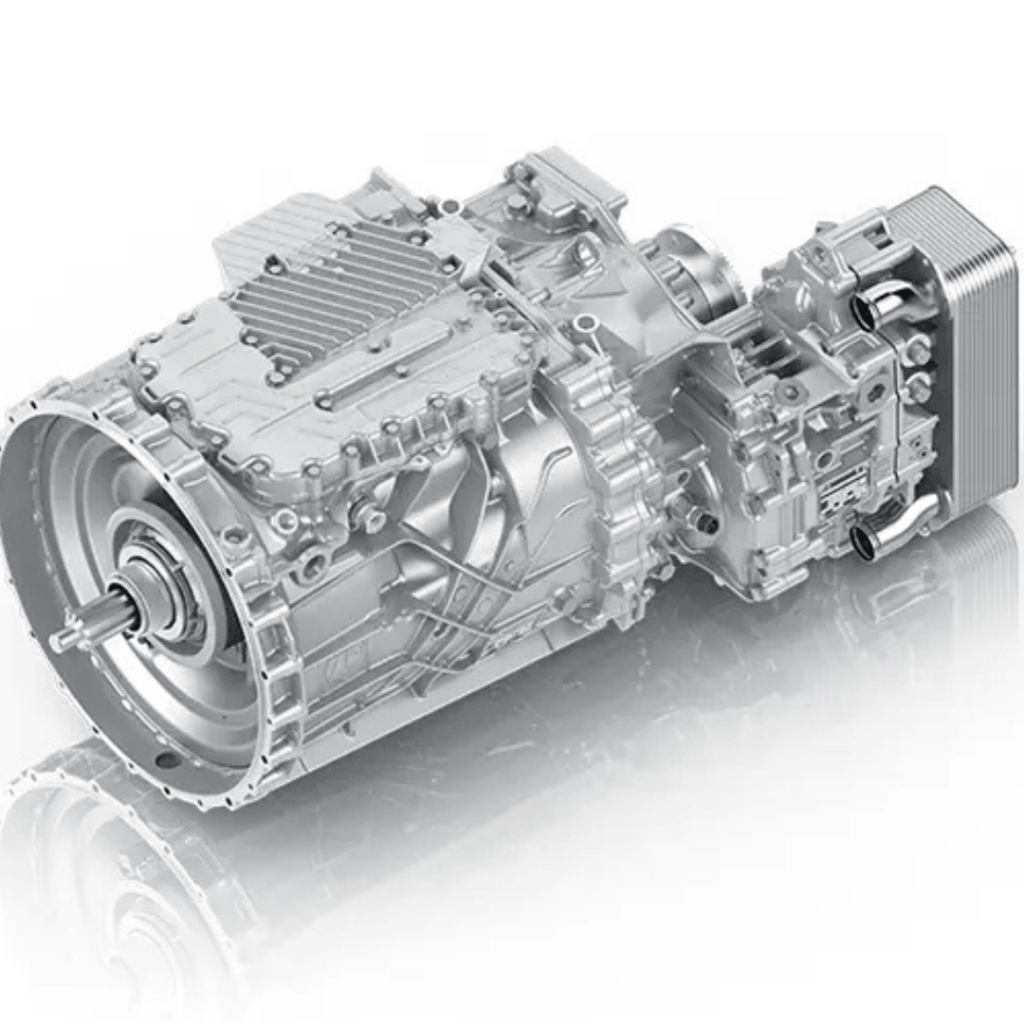
A Traxon out of service isn’t a minor inconvenience — on a crane, wheel loader, or haul truck, it’s the whole machine sitting idle while the schedule slips. Precision Transmission provides ZF Traxon transmission repair for off-highway and heavy-duty equipment, backed by our ZF Off-Highway distributor relationship and three in-house dynamometers. Here’s what to watch for, how we handle the repair itself, and which equipment and maintenance intervals keep a Traxon out of our shop in the first place.
What Is a ZF Traxon Transmission
The Traxon is ZF’s automated manual transmission platform built for off-highway and heavy-duty applications — not a torque-converter automatic, and not a manual with a shift assist bolted on. It uses electronically controlled clutch actuation, managed by a TCU (transmission control unit) that times shifts based on load, grade, and engine torque. That control architecture is precise, but it also means a Traxon fault is just as likely to be electronic — a bad sensor input, a corrupted TCU parameter — as it is mechanical. You’ll find Traxon units in cranes, wheel loaders, haul trucks, and other off-highway equipment where automated shifting under variable load is a real operational advantage over a standard manual.
Signs Your TraXon Transmission Needs Repair
A Traxon’s electronically controlled clutch actuation means trouble usually shows up as a specific, nameable symptom rather than a vague “it feels off.” Watch for:
- Delayed or hesitant engagement — a noticeable lag between shift command and the machine actually moving, often a sign of clutch pack wear.
- Active TCU fault codes — an intermittent code is an early warning, not something to ignore because the machine “still runs fine.”
- Slipping under load — power loss when the equipment is working hardest, which is when a Traxon issue costs the most in lost productivity.
- Fluid that looks or smells burnt — the TCU depends on consistent hydraulic pressure, so degraded fluid shows up as a control problem before it shows up as a mechanical one.
If you’re seeing these and want to understand the underlying cause in more depth before bringing the unit in, our ZF Traxon transmission problems post walks through diagnosis symptom by symptom.
How We Handle ZF Traxon Transmission Repair
Every ZF Traxon transmission repair starts with reading the fault codes through ZF-specific diagnostic software, not guessing from symptoms. A Traxon fault is as likely to be electronic — a bad sensor, a corrupted TCU parameter — as it is mechanical, so we confirm the actual cause before deciding on a path.
From there, the fix depends on what’s actually failed:
Repair
Fits an isolated, confirmed issue — a sensor, a solenoid, a TCU parameter reset — where the rest of the unit tests out clean on our dynamometers.
Full Rebuild
The right call for worn clutch packs, degraded bearings, or fluid contamination with a documented overheating history. We disassemble, replace the wear parts, and rebuild to spec instead of chasing individual symptoms one at a time.
Remanufactured OEM Exchange
Comes into play when the core is too far gone — severe gear damage, a cracked case, or a unit run dry. Because we carry ZF Off-Highway parts through our distributor relationship, exchange units can often be built in 3-5 days, which matters when a crane or loader needs to get back to work. A rebuild-only approach — replacing just the failed part with limited testing — is the lowest-cost option but carries the highest risk of a repeat failure, so we treat it as a stopgap, not a long-term fix.
As a ZF Off-Highway distributor, we have OEM-level parts access and factory technical documentation for Traxon specifically, along with the rest of the ZF off-highway line — Ecomat, Ecolife, AS Tronic, and TC Tronic. That matters if your fleet runs mixed ZF platforms and you’d rather work with one shop that knows all of them at the model-number level than juggle multiple vendors.
TraXon Vehicles We Service and Preventive Maintenance
Traxon shows up across a wide range of off-highway and heavy-duty applications — cranes, construction equipment, wheel loaders, and haul trucks among them. The duty cycle varies by application, but the maintenance that keeps a Traxon out of the repair queue doesn’t:
- Fluid changes on schedule — since fluid condition directly affects the TCU’s ability to actuate the clutches precisely.
- Cooler line inspection — sustained high-load cycles like crane lifting or loader digging push a lot of heat through the transmission, and a partially restricted cooler line accelerates wear on clutch packs and seals over time.
- Fault code monitoring as routine, not reactive — checking codes on a schedule rather than only after a symptom appears.
- Operator technique — aggressive direction changes and lugging under load put avoidable stress on the clutch packs, regardless of application.
Frequently Asked Questions
How do I know if my Traxon issue is electronic or mechanical?
Fault codes are the fastest way to tell. A code pointing to a specific sensor or solenoid usually means an electronic fix; consistent slipping across multiple gears with no active codes points toward clutch pack wear. We run full diagnostics before recommending either path.
Can a Traxon transmission be rebuilt, or does it need full replacement?
Most Traxon issues can be rebuilt if caught before they cause secondary damage — worn clutch packs and degraded seals are routine rebuild work. Replacement with a remanufactured exchange unit becomes the better option when there’s structural damage to the case or severe gear damage.
Do you service Traxon units outside of construction equipment?
Yes. Traxon is used across cranes, construction equipment, and other off-highway platforms, and our distributor-level access to ZF parts and documentation covers the line regardless of the application it’s installed in.
How long does a Traxon repair typically take?
It depends on what’s actually wrong — an isolated fix is faster than a full rebuild. For a reman exchange, our core inventory often allows units to be built in 3-5 days. Contact us with your specific unit and symptoms and we’ll give you a realistic timeline.
Get Your Traxon Transmission Back in Service
A Traxon issue left undiagnosed tends to get more expensive, not less — a soft clutch engagement today is a full rebuild in six months if the root cause isn’t addressed. Between our distributor-level parts access and three in-house dynamometers, every repair or reman unit we send back gets tested to spec before it leaves, not just eyeballed.
If you’re dealing with a Traxon that’s slipping, throwing codes, or overheating, reach out through our contact page. Tell us the unit, the symptoms, and your timeline — we’ll route you to the right specialist at our Colmar, PA (215-822-8300) or Fort Myers, FL (888-343-8912) facility.